
An illustrated exploration of the inseparable trinity — kihon, kata, and kumite — leading to the ultimate focus known as kime.
Kihon · Kata · Kumite — One Body, One Mind, One Strike
Karate is not a collection of isolated skills. It is a living system — a seamless continuum where every punch thrown in the dojo, every stance held in silence, and every exchange of blows in sparring are expressions of the same underlying truth. The Japan Karate Association has spent over seven decades refining this understanding into the most rigorous and scientifically structured training methodology in the martial arts world.
The trinity of kihon (basics), kata (forms), and kumite (sparring) is not a hierarchy but a circle. Each element feeds the others. Remove one, and the entire structure collapses into empty motion. Master all three as a unified whole, and you unlock the devastating, instantaneous focus known as kime — the moment where body, breath, spirit, and technique converge into a single point of absolute power.
This understanding did not arrive overnight. Gichin Funakoshi carried karate from Okinawa to mainland Japan in 1922, presenting it first as a discipline of physical education before it was recognized as a complete martial art. His students carried the work forward, and in 1949 the Japan Karate Association was formally established in Tokyo, with Funakoshi as its honorary chief instructor. Under Masatoshi Nakayama's later stewardship, the JKA built the instructor-training program, competitive rule set, and standardized curriculum that turned a regional Okinawan fighting art into a global discipline practiced in over a hundred countries.
Every JKA class still opens and closes with a recitation of the Dojo Kun — five vows that place character above combat — and every serious student eventually studies Funakoshi's broader precepts, known as the Niju Kun. These are not decorations. They are the philosophical spine that keeps the trinity oriented toward something larger than winning.
Recited at the start and end of every JKA class, these five vows are the ethical foundation beneath every stance and strike.
Funakoshi left twenty guiding principles for life inside and outside the dojo. A few that shape the JKA's entire approach to training:
The Dojo — Where Spirit Is Forged
At the JKA, these three elements are never taught in isolation. From the very first class, the student experiences their interconnection. A front kick practiced in kihon appears in the kata Heian Sandan; the timing learned in that kata surfaces instinctively during kumite. The trinity is a single river with three currents.
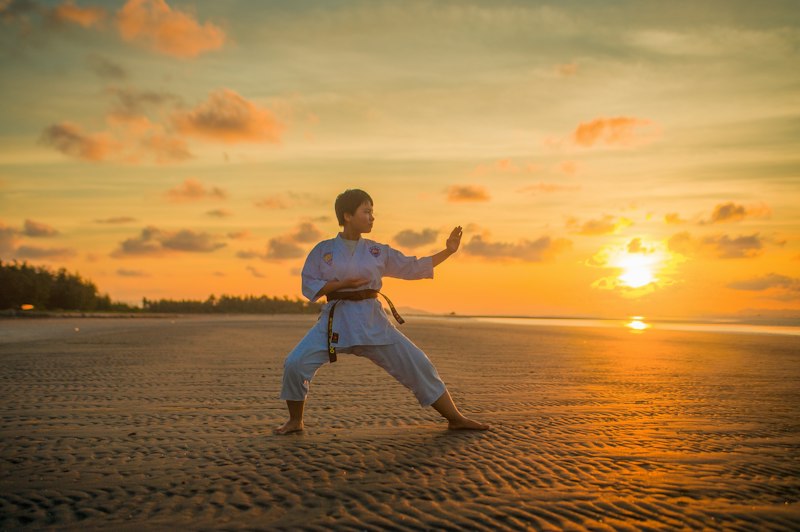
The bedrock upon which all karate is built. Kihon encompasses every stance, strike, block, and kick — drilled thousands of times until the body moves with mechanical precision and zero wasted energy. At the JKA, kihon is taught with scientific exactitude: the precise angle of the hip rotation, the millimeter-accurate placement of the heel, the exact moment of muscular contraction. Without flawless kihon, kata becomes pantomime and kumite becomes brawling.
Kata is the encyclopedia of karate combat encoded into choreographed sequences. The JKA's 27 standard kata contain every conceivable attack, defense, and counter — compressed into flowing patterns that train the body to react without conscious thought. Through relentless repetition, the kata moves from the intellect to the nervous system. The practitioner no longer "performs" the kata; the kata performs itself through the practitioner, freeing the mind for total awareness.
Kumite is where the trinity is tested under pressure. The JKA's progressive sparring system — from gohon kumite (five-step) through jiyu ippon (semi-free) to jiyu kumite (free sparring) — ensures that every technique learned in kihon and kata is pressure-tested against a resisting, unpredictable opponent. Kumite without kata lacks depth; kumite without kihon lacks precision. Together, they forge a fighter who is both technically flawless and adaptively brilliant.
The JKA's approach to kihon is unmatched in its analytical rigor. Where other schools may rely on tradition alone, the JKA has dissected every fundamental technique using principles of biomechanics, kinesiology, and physics. The result is a training system that produces techniques of extraordinary speed, power, and efficiency.
A single oi-zuki (lunge punch) — seemingly the simplest technique in karate — involves a precisely coordinated chain of events: the drive from the rear foot, the rotation of the hips along a horizontal plane, the snapping extension of the elbow, the tightening of the latissimus dorsi, and the final clenching of the fist at the exact moment of impact. Every element must fire in the correct sequence within a fraction of a second. The JKA breaks this down into teachable, measurable components so that even a beginner can begin building toward mastery from day one.
The stance is the root of all power. The JKA emphasizes deep, stable stances that develop extraordinary leg strength and hip mobility.
JKA punching technique is legendary for its linear speed and penetrating power, generated through hip rotation and ground reaction force.
In JKA karate, a block is never merely defensive. Every uke is a strike disguised as a defense — redirecting, damaging, and creating openings simultaneously.
JKA kicks combine the snap of the knee with the drive of the hip, producing techniques that are both blindingly fast and devastatingly powerful.
Technique alone does not build kihon; the JKA's drilling method is what carves it into the body. Three stages carry every technique from concept to reflex.
Repetition Is the Mother of Mastery
The JKA canon comprises roughly 26 to 27 standard kata depending on lineage, each a masterwork of combative engineering passed down through generations of Okinawan and Japanese masters. These are not dances or performances — they are combat simulations against multiple imaginary opponents, encoding centuries of battlefield knowledge into memorizable sequences.
The genius of the JKA's kata system lies in its progressive architecture. The five Heian kata introduce fundamental movements in a logical sequence. The Tekki kata develop lateral power and close-quarters fighting from a fixed, rooted stance. The mid-level kata — Bassai and Kanku — expand the vocabulary of stances and timing dramatically. And the deeper canon layers increasingly sophisticated combinations, rhythm changes, and explosive transitions that mirror the chaos of real combat.
Under the JKA system, kata is refined to be directly applicable to kumite. Every movement has a practical interpretation (bunkai). The deep stances of kata training build the leg strength and hip flexibility that make kumite techniques explosive. The breathing patterns learned in kata regulate the fighter's composure under pressure. Kata is the bridge between isolated technique and living combat, and the curriculum below is typically studied in roughly this order across a karateka's kyu and dan grades.
The gateway kata, studied from white belt onward. Five progressive forms that build the complete foundation of Shotokan karate.
Performed entirely in kiba-dachi along a single line, the Tekki kata trade mobility for raw lateral power and close-range fighting skill.
The first kata most students meet after black belt, expanding stance work, timing, and combative range far beyond the Heian series.
The remaining kata of the JKA syllabus, each contributing a distinct rhythm, principle, or historical lineage to the complete system.
Kumite is where theory meets reality. The JKA's sparring methodology is the most systematic and progressive in the world, designed to build a fighter's skills incrementally while maintaining the technical integrity of Shotokan karate. Unlike sport-oriented systems that sacrifice form for points, JKA kumite demands that every scoring technique demonstrate proper form, correct distance, decisive timing, and full zanshin (continuing awareness).
The progression begins with gohon kumite (five-step sparring), where the attacker advances with five identical attacks and the defender retreats with five identical blocks before delivering a counter. This teaches distance, timing, and composure under attack. The student then advances through sanbon (three-step), ippon (one-step), and jiyu ippon (semi-free one-step), each stage increasing the speed, unpredictability, and pressure. Finally, jiyu kumite (free sparring) tests the student's ability to apply the entire trinity under fully dynamic, unscripted conditions.
The JKA's step-by-step sparring curriculum ensures that no student faces chaos before mastering control.
The invisible architecture that separates JKA kumite from mere fighting.
Where JKA kumite meets the tournament floor, a scoring technique must satisfy several criteria simultaneously — not merely land first.
The JKA's technical system was not created in a vacuum. It is the living inheritance of a lineage of extraordinary martial artists who dedicated their entire lives to the perfection of karate-do. Each master contributed unique insights that shaped the trinity into the integrated system practiced by millions worldwide today.
The father of modern karate brought the art from Okinawa to mainland Japan in 1922, forever changing the martial arts landscape. Funakoshi Sensei believed that karate was fundamentally a way of character development — a path of self-perfection that transcended mere fighting. His famous twenty precepts (Niju Kun) remain the philosophical backbone of JKA training. He insisted that kata was the soul of karate and that every technique must be performed with absolute sincerity and full spiritual commitment.
The architect of the modern JKA system. Nakayama Sensei transformed Funakoshi's traditional teachings into a scientifically structured curriculum that could be taught systematically to students of all levels across the globe. His monumental 11-volume series Best Karate remains the definitive technical reference for Shotokan karate. He pioneered the JKA's instructor training program, the kumite competition rules, and the standardized kata system that unified Shotokan practice worldwide. Under his leadership, the JKA became the largest and most influential karate organization in history.
One of the most technically gifted karateka in history, Kanazawa Sensei was the only person to win both the kata and kumite championships at the All-Japan Karate Tournament in the same year (1957) — and he did so with a broken hand. His karate was characterized by extraordinary fluidity, explosive speed, and devastating kime. He later founded the Shotokan Karate International Federation (SKIF) but his formative years at the JKA helped shape the technical standards that define the organization to this day. His kata performances were legendary for their perfect balance of power and grace.
Known universally as "The Tiger" for his ferocious kumite and thunderous kime, Enoeda Sensei was the embodiment of the JKA's fighting spirit. A three-time All-Japan kumite champion, he brought Shotokan karate to the United Kingdom in 1965 and built one of the strongest karate communities outside Japan. His technique was characterized by overwhelming forward pressure, devastating gyaku-zuki, and an indomitable fighting spirit that inspired generations of karateka. He demonstrated that the trinity of kihon-kata-kumite, when unified with total commitment, produces a martial artist of terrifying effectiveness.

The current torchbearer of the JKA tradition, Kagawa Shihan represents the living evolution of the trinity system. A dominant competitor in his youth — winning multiple All-Japan and World Championship titles in both kata and kumite — he now dedicates his life to preserving and advancing the JKA's technical legacy. His karate is renowned for its razor-sharp precision, explosive hip vibration, and kime that seems to crack the air itself. Under his guidance, the JKA continues to produce the most technically refined karateka in the world, proving that the trinity system is as vital and effective today as it was when Funakoshi first brought karate to Tokyo.
Kime (極め) — from the Japanese verb kimeru, meaning "to decide" or "to fix" — is the instantaneous focusing of all physical and mental energy into a single point at the moment of impact. It is the culmination of the entire trinity: the structural precision of kihon, the unconscious fluency of kata, and the adaptive timing of kumite, all converging in a fraction of a second.
When kime is achieved, the entire body — from the balls of the feet through the legs, hips, torso, shoulders, and arms — becomes a single unified weapon. The muscles contract explosively at the moment of impact and then instantly relax, producing a technique that is simultaneously devastatingly powerful and lightning-fast. The breath is expelled in a sharp kiai, the eyes lock onto the target with absolute focus, and the spirit projects forward with total commitment.
This is the moment that separates karate from all other martial arts. This is the one blow that ends the fight. This is the ultimate purpose of every hour spent drilling kihon, every thousand repetitions of kata, every bruising exchange in kumite. The trinity exists to produce kime. And kime, once achieved, validates the trinity.
One mind. One body. One moment. One strike.
The JKA's dan grading system represents a lifetime journey through the trinity. Each rank demands deeper integration of kihon, kata, and kumite, with the technical and spiritual requirements increasing exponentially at each level.
Before dan grades come the kyu ranks — the colored belts, typically numbered downward from 9th or 10th kyu to 1st kyu, marking a student's steady climb toward the black belt. Everything below is what comes after that climb begins in earnest.
The black belt is not the end but the beginning. Shodan demonstrates that the student has internalized the fundamental trinity: clean kihon, competent kata (Heian series + Tekki Shodan + one advanced kata), and controlled kumite with proper maai and zanshin. The foundation is laid; the real work begins.
Nidan asks the karateka to prove Shodan was not a fluke. Techniques are tested for consistency under fatigue and pressure, kata gains speed without sacrificing form, and kumite begins to show individual timing rather than textbook responses.
By Sandan, the karateka's techniques begin to show genuine kime. The kihon is sharp and powerful, the kata demonstrates rhythm and breathing, and the kumite shows tactical intelligence. The trinity is no longer three separate practices but a unified expression of the karateka's growing understanding.
Yondan typically marks the point where a karateka is trusted to shape other students' fundamentals. Personal technique must now be strong enough to survive the scrutiny of explaining it, kata to survive demonstrating it slowly, and kumite to survive teaching timing to a beginner without losing it themselves.
Godan represents the transition from advanced student to true master. The karateka's techniques are now driven by the hips and the breath rather than muscular effort. Kata is performed with effortless power and deep bunkai understanding. Kumite is characterized by sen-no-sen (preemptive initiative) and devastating single-technique finishing power.
Few karateka still compete at Rokudan; the emphasis shifts fully to instruction and preservation of technical detail. Kata is judged less on athleticism and more on the accuracy of every angle, and kumite is valued for economy — doing less, more precisely.
At Nanadan, a karateka is generally recognized as a custodian of the JKA's technical standards rather than merely a practitioner of them — someone whose interpretation of a kata's fine detail carries real weight within the organization.
At this rarefied level, the master's karate transcends technique. Every movement — walking, sitting, breathing — is an expression of the trinity. Kime is no longer something the master "does"; it is something the master "is." The separation between kihon, kata, and kumite has dissolved entirely. There is only karate.
Kudan is awarded rarely, generally to those whose entire adult life has been spent in service of the art — teaching, organizing, and safeguarding the trinity system for the generations that follow them.
The highest rank the JKA lineage recognizes, held historically by only a handful of figures. Judan is less a technical grade than a historical acknowledgment — a life so completely given to kihon, kata, and kumite that the three ceased, long ago, to be separate things at all.
The Way of the Empty Hand
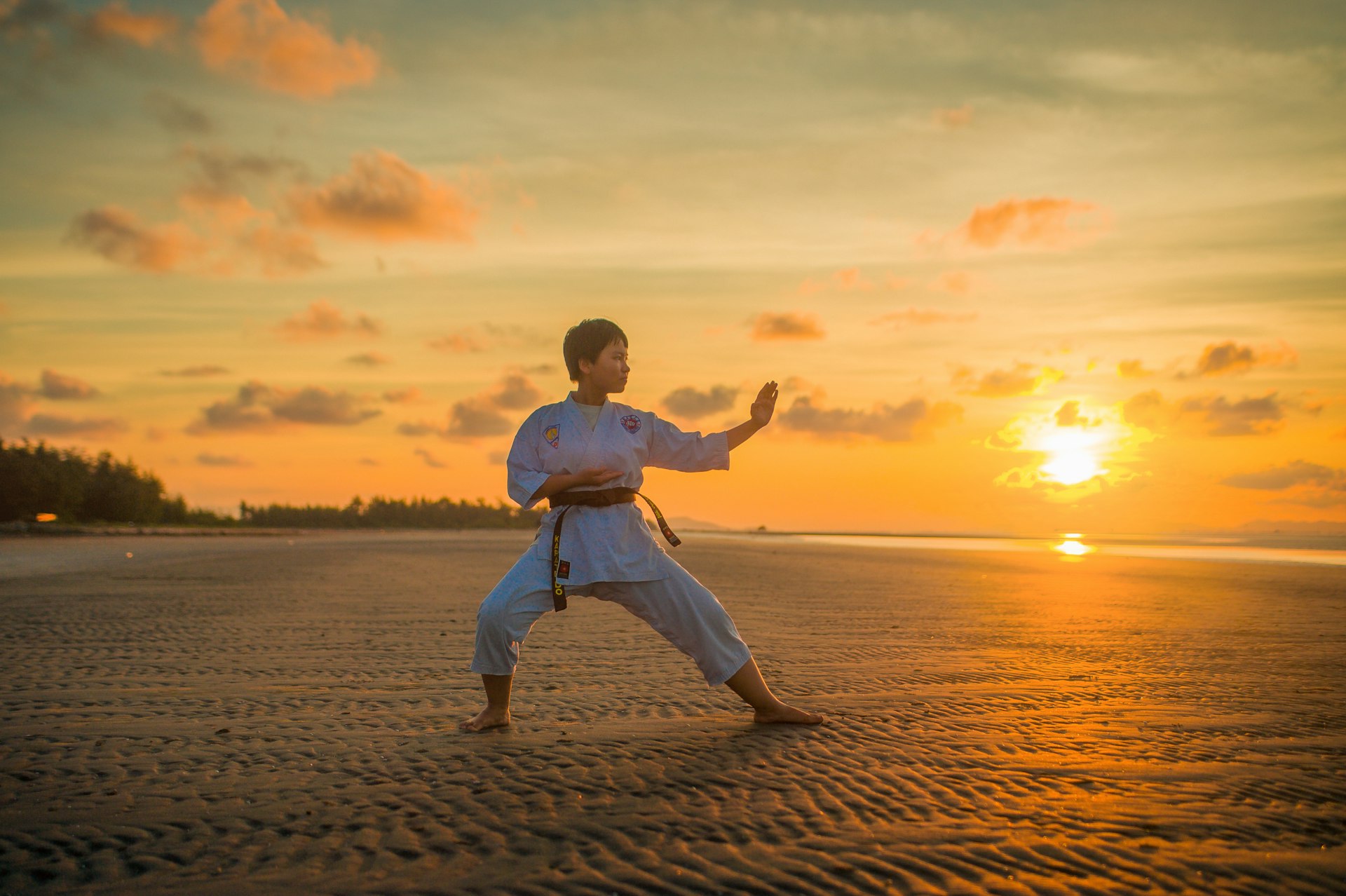
Train the kihon until your body moves without thought. Practice the kata until the forms breathe through you. Engage in kumite until your spirit is unbreakable. And when the moment comes — when body, mind, and technique converge into a single point of absolute focus — you will understand why the JKA calls this the inseparable trinity.
Kihon is Kata is Kumite is Kime.